Written by: Zohair Ammar
Date: 2026-06-24
Why the 2026 World Cup's Greatest Strength Is Also Its Most Dangerous Gamble
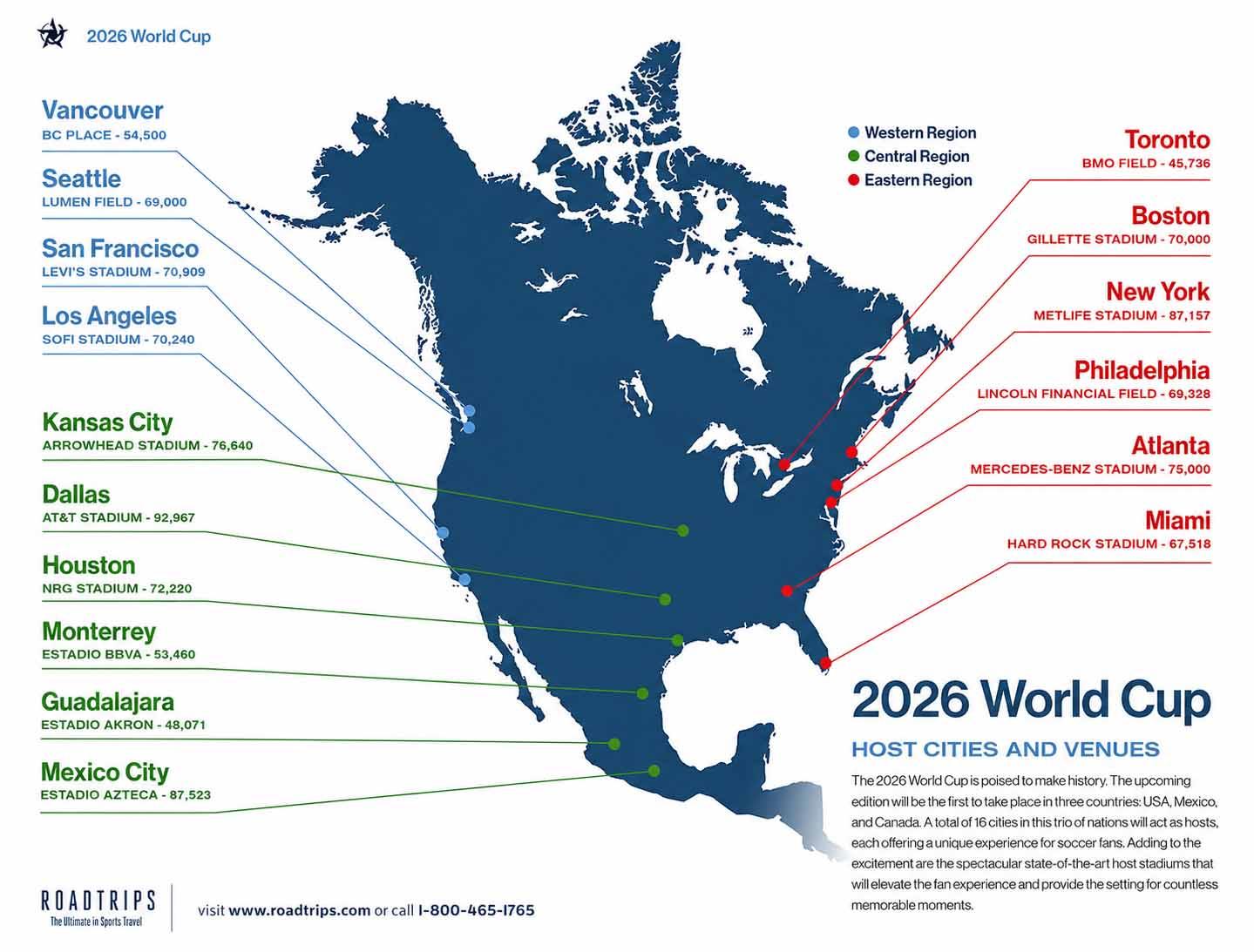
For decades, the formula was simple. One country. Eight to twelve stadiums. Thirty-one days of football. Then the party ended, often leaving behind a graveyard of debt-ridden infrastructure and underused concrete bowls. The 2026 World Cup shatters that template. By awarding the tournament to the United States, Canada, and Mexico, FIFA has created the biggest and most exciting edition to date: forty-eight teams, one hundred and four fixtures, and a tri-nation handshake across five thousand kilometres, three time zones, two languages, and three entirely separate immigration systems.
The economic promise is staggering. A new study conducted by independent analysts OpenEconomics (OE), released by FIFA and the World Trade Organisation, projects that the 2026 World Cup alone will contribute $40.9 billion to global GDP and support 824,000 full-time equivalent jobs worldwide.
The upcoming FIFA World Cup 2026 is set to be a historic milestone in international football, marking the first time the tournament expands to a 48-team format and is co-hosted by three nations: Canada, Mexico, and the United States.
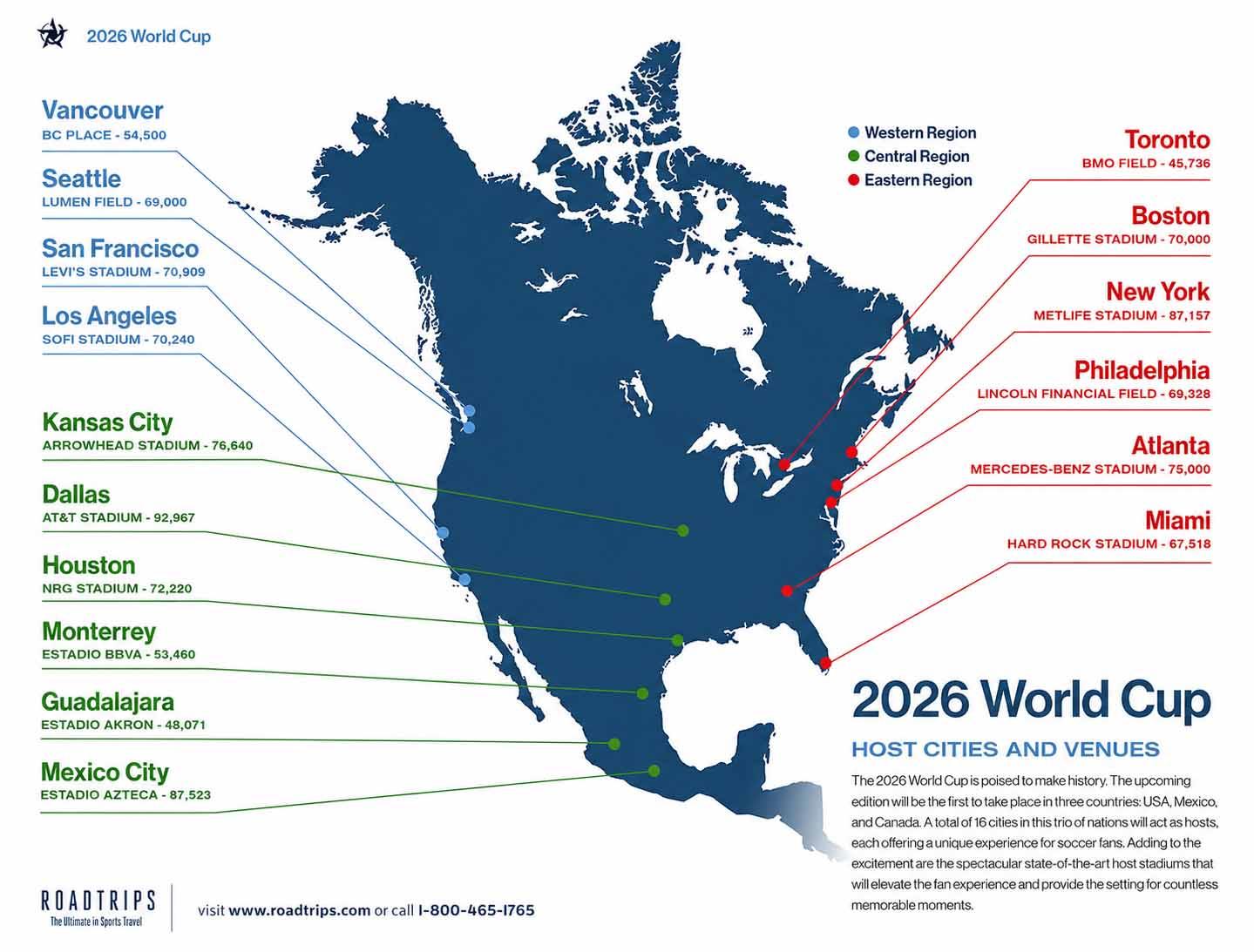
This ambitious expansion is designed to elevate the global profile of the sport, offering a 39-day stage for top national teams from every FIFA confederation. Spanning 16 host cities across North America—including 11 in the U.S., such as New York/New Jersey, Los Angeles, and Miami—the event leverages the region's robust sports infrastructure and deep-seated passion for the game. Beyond the pitch, the tournament is expected to draw an unprecedented 6.5 million attendees, creating a surge in global participation and visibility for the host cities.
The economic footprint of the 2026 tournament is vast, with total event-related expenditures estimated at $13.9 billion. This includes $3.8 billion in FIFA expenditures, $1.8 billion for host city operations, and $0.9 billion in capital investments, but the most significant driver is the projected $7.5 billion in tourist spending. In the United States alone, expenditures are expected to reach $11.1 billion. These financial injections are forecast to generate a massive global gross output of $80.1 billion and contribute $40.9 billion to global GDP. Furthermore, the event is anticipated to support approximately 824,000 full-time equivalent jobs worldwide, with 185,000 of those positions located within the United States.
Beyond traditional financial metrics, the study adopts a Social Return on Investment (SROI) framework to quantify the tournament's intangible benefits, such as improvements in public health and community well-being. By encouraging physical activity, the event is expected to generate significant healthcare savings and even contribute to a reduction in crime rates due to increased community engagement. Globally, these social benefits are valued at $8.28 billion, while in the United States, they are estimated at $6.88 billion. The resulting SROI ratio of 3.64 globally and 4.03 for the U.S. indicates that for every dollar invested, society receives several times that amount in combined social and economic value.
This holistic approach highlights the World Cup's role as a catalyst for long-term positive change that extends far beyond the final whistle.
Yet the unspoken reality is more precarious. The multi-national model gets some things right. It distributes the crushing burden that broke Brazil in 2014, where an estimated $15 billion was spent largely on stadiums that now host sparse crowds or function as oversized bus depots. By contrast, all sixteen host cities in 2026 already possess professional-grade venues. The United States contributes to NFL cathedrals like MetLife and AT&T Stadium. Mexico offers legendary grounds, including a renovated Azteca. Canada provides modern CFL and MLS facilities. No single nation will collapse under post-tournament maintenance costs. The sprawling map from Vancouver to Mexico City to Miami disperses crowds and economic benefit rather than funnelling millions into two or three overrun cities, meaning a supporter following Argentina could reasonably book hotels in Houston, Guadalajara, and Seattle without encountering the same apocalyptic surcharge twice. And if one host nation suffers a customs strike, a security lapse, or a public health crisis, the tournament retains flexibility. Three governments share the burden of failure, providing genuine resilience.
But these advantages are fragile. Against them stands a set of challenges so fundamental that they threaten to overwhelm the entire undertaking. Consider the carbon contradiction. FIFA has signed the UN Sports for Climate Action Framework, yet a single team like Germany could fly from Los Angeles to Vancouver for the round of sixteen, a three-hour flight, then to Mexico City for the quarter-final, another five hours, then to Atlanta for the semi-final, three hours, and finally to New York for the final, two more hours. Multiply that by forty-eight teams. Add hundreds of thousands of fans crisscrossing a continent. Add team entourages, officials, media, and commercial partners.
While the FIFA World Cup 2026 presents a visionary leap for international football, the logistical and environmental scale of a tri-national, 48-team tournament introduces significant challenges. Central to these concerns is the substantial carbon footprint generated by expansive travel, which contrasts sharply with global sustainability goals. Additionally, the complexity of coordinating visa and border policies across three sovereign nations—Canada, Mexico, and the United States—risks making the event inaccessible to many fans from Africa, Asia, and South America, potentially leaving seats empty despite the tournament’s inclusive expansion.
The physical toll on participants is equally demanding, as the 2026 schedule features the longest travel distances in the competition's history. Players and media must navigate multiple time zones, high altitudes in Mexico City, and extreme humidity in the American South, conditions that may impair performance and increase injury risks. Furthermore, the concentration of knockout matches within the United States creates a potential psychological imbalance for co-hosts Canada and Mexico, raising questions about whether the tournament can maintain a unified spirit of celebration across such a vast and climatically diverse geographic area.
Success hinges on unprecedented diplomatic and operational synchronisation to prevent bureaucratic friction, such as conflicting advertising laws or labour disputes, from overshadowing the sport. Despite these hurdles, the economic potential is immense, with projections suggesting a $62 billion boost to global GDP. If managed effectively, this model could provide a sustainable blueprint for future multi-nation hosting, proving that shared responsibility can distribute economic benefits more equitably while sparing individual nations the burden of sole hosting.
We highly commend FIFA’s bold efforts to take global football a mile ahead by embracing this ambitious format, which fosters international cooperation and broadens the game's horizons. We extend our warmest best wishes for this grand experiment. Furthermore, we wish the greatest success to the participating Arabic and African nations—including Egypt, Morocco, Algeria, Tunisia, Nigeria, Senegal, Cameroon, Saudi Arabia, and Qatar—as they carry the hopes of their regions into this historic competition. May the 2026 World Cup be a triumphant celebration of unity and excellence.